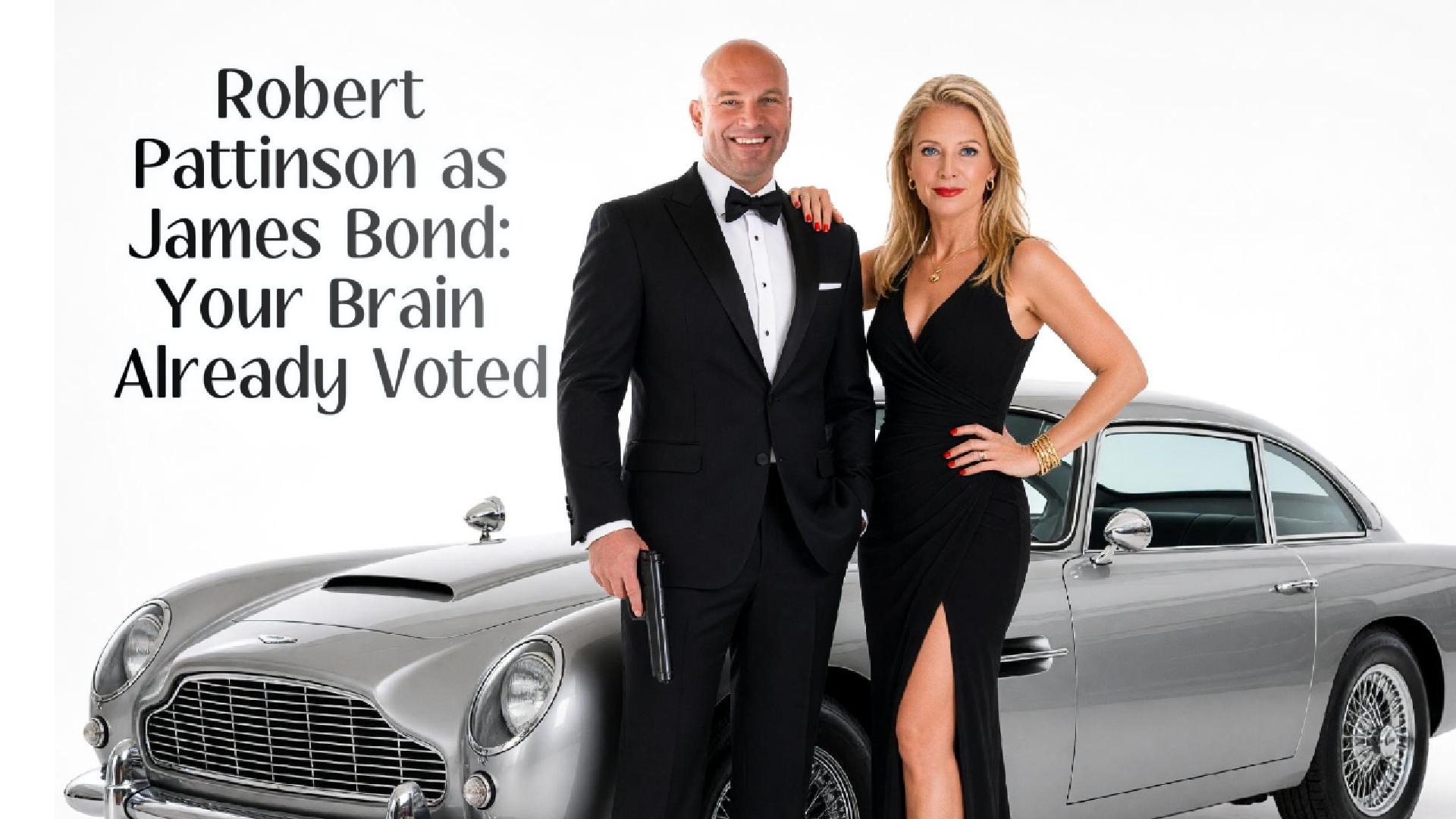
Robert Pattinson as James Bond: Your Brain Already Voted
Yesterday morning, Amazon announced that Robert Pattinson is the next James Bond. Forty years old. The vampire from Twilight, then Batman, now 007.
And before you finished reading that sentence, your brain had already voted.
It took about 0.3 seconds. That is how long your primal brain needs to decide whether someone seems ok. Not an opinion. Not an analysis. A verdict, delivered before you knew anyone was asking.
Then your rational brain showed up, late, with a very convincing story about why it agrees with the verdict. Or disagrees. Either way, it took the credit.
I am going to show you what happened in my head yesterday, because it went through three voices in about ten seconds. And then I will show you where those same three voices are quietly costing you clients, trust and intimacy.
Voice one, the primal brain. I watched the announcement. The tuxedo, the gun, the look. And my first thought was: damn, that glance is Bondesque.
I did not decide that. It happened to me. That is the primal brain doing its job: survival, emotion, gain, contrast. Is this guy a threat or an ally? Does he stand out? Would I follow him into a room? Done, in 0.3 seconds.
Voice two, the rational brain. A few seconds later it walked in. Too nice. Too polite. Too much the boy from Twilight.
Notice what it did. It did not analyze anything. It explained. It grabbed an old image from my head, a pretty face in a vampire movie, and built a story around it. Sounded smart. Zero evidence. Nobody on this planet has seen one frame of this film. There is no release date, and filming is not expected before next year. My rational brain was writing a review of a movie that does not exist.
And here is the part that matters: this time the explanation even argued against my first reaction. So the rational brain is not neutral, and it is not the decider. It is a storyteller, and it will tell whatever story makes you feel like a reasonable person.
Voice three, the business owner. The one that has signed contracts, hired people and been wrong about both. It said: give him a chance. Let's see what he does. Waiting costs me nothing. Writing him off could cost me a great Bond.
Look at what that third voice did. It did not silence the first two. It did not pretend the glance never happened. It put a date on the decision. Let's see. That is the difference between an executive and a commentator.
You might think I am unusually open minded. I am not. I am just old enough to remember how this movie ends.
October 14, 2005. Daniel Craig is announced as Bond. The internet goes berserk. James Blonde. A website calling for a boycott of a film that did not exist yet. People who had never met the man decided he was wrong for the role because of his hair.
Then Casino Royale came out and made more than 600 million dollars worldwide, and a surprising number of skeptics suddenly remembered they had always believed in him.
Same pattern, every time. Verdict first. Story second. And when reality disagrees, we quietly forget we ever said it, because saying I was wrong feels like losing status.
Now look at what Amazon did, because this part is for business owners.
They did not publish a three page explanation of Pattinson's range. They released a short video. A man in a tuxedo. A gun in his hand. And four words at the end: James Bond will return.
Image first. Contrast. Status. No explanation. The explanation comes later, in the cinema, when people are already emotionally in. Whether that video runs 11 seconds or 30, the logic is the 11 second logic: a studio about to bet its biggest franchise on one face knows that the first seconds decide whether anybody gives the rest a chance.
Do you know that about your own business?
Now take Bond out of the room and put yourself in it.
You do the Pattinson thing every single day, and nobody writes a headline about it.
The candidate you filed under not senior enough during the handshake. The supplier who looked wrong. The idea your own team pitched on Tuesday that you killed on Wednesday because it sounded like something you tried in 2019. The prospect whose first email felt off, so you never replied, and who became a great client for your competitor.
Every one of those is a verdict, a story and no test. And not one of them shows up on a report, because the deal that never happened is not a line item.
It is a reputation problem too. When your team learns that ideas die in the first ten seconds, they stop bringing you ideas. The meetings get quiet and you think everything is fine.
And at home, your partner says what if we spent a year on the coast, and you hear a no before the sentence ends. Same reflex, same story: we can't, the business. Your partner hears that no too. Then stops asking. Then you wonder why the two of you feel like colleagues.
The subconscious frustration underneath all of this is not stupidity. It is the fear of being fooled again, of paying for a wrong call in front of people who are watching you. So your brain judges fast to protect you, and you cannot switch that off.
And you are allowed to want to be right. You are allowed to want to be the one who sees it first, the one people remember. You are allowed to want this.
The goal is not to kill your first reaction. It is to stop letting it sign the contract alone.
Here is what I did yesterday, and what you can do after this video. Three moves. It takes less time than the intro.
Move one, catch the verdict. Say your first reaction out loud, or write it down, within about seven seconds, before the story arrives. Mine was: the glance is Bondesque. Not he would be good, not he would be bad. Just the raw hit. Wait a minute and your rational brain will have edited it into something respectable.
Move two, separate evidence from story. Take the second voice and ask it two questions. What do I actually know? What am I filling in? What I actually knew: one short video and a filmography. What I was filling in: everything else. If your what I actually know column is empty, you are not analyzing. You are narrating.
Move three, price the test. Ask the business owner question. What does it cost me to wait? What does it cost me to be wrong? When will I have real data? Then put a date on it. I judge after the trailer. I judge after ninety days with this hire. This idea gets one real week. A decision with a date is a test. A decision without one is a prejudice.
If you want a place to do this, Brain Trigger is the Make Me Great! system in your pocket. After a conversation that mattered, you talk for 20 seconds and it gives you your next move. Your first move is free. Comment DEBRIEF and the link lands in your messages.
And one last thing, flip it. You are the Bond to everyone you meet. Same 0.3 seconds, same story coming right after. So what is your announcement video? What do they see and hear in your first seconds? If it takes you a paragraph to explain why you are great, the primal brain has already left the room.
So where did I land? Exactly where the business owner in me landed: let's see.
I loved the glance. I doubted the softness. And I have zero evidence either way until Denis Villeneuve has shot something. That is not weakness. That is a verdict with a date on it. And if he is great, I will say I was wrong about too nice, and nobody will have to rewrite my memory.
Here is what I want you to keep. Your brain will judge in 0.3 seconds, and you cannot stop it. Your rational brain will explain that judgment convincingly, and you cannot stop that either. What you can do is hold the third voice, the one that says let's see, and put a date on it. That is where the money, the trust and the intimacy are.
Brain Trigger is the Make Me Great! system in your pocket. After your next conversation that matters, a hire, a client, the person you go home to, talk for 20 seconds and get your next move. Your first move is free.
Get it here : https://braintrigger.happy-brains.com/go.
Be Great!