The Conversation Is Over. Your Brain Is Still Replaying It
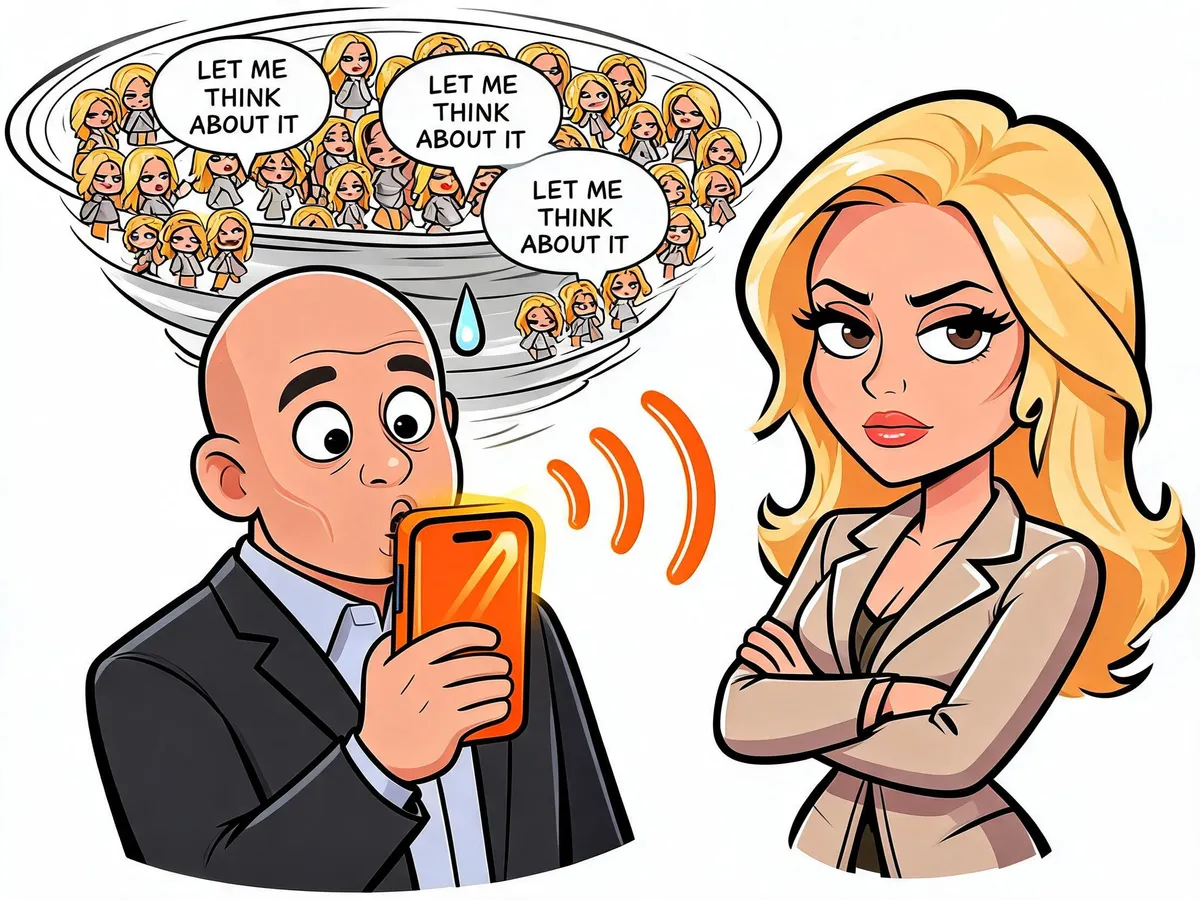
A client says, "Let me think about it."
You nod. You smile. You say of course, take all the time you need. Then you drive home, and for the next three hours you replay the conversation. Was it the price? Was it something you said in minute twelve? Do you chase her tomorrow, or does chasing make it worse?
Here is the brain fact that changes that evening. When a client says let me think about it, her brain is rarely weighing your price. It is checking whether saying yes could get her blamed later, and a delay feels safer than a no. Your own rational brain then spends the night explaining something it never actually saw.
Now move the same scene into your kitchen. Your partner says, "It's fine." It was not fine. Or into your Monday meeting, where you made a perfectly good point and nobody reacted at all.
Three rooms, one problem. In the first, the subconscious frustration is that the deal is slipping and next month depends on it. In the second, it is wanting to be understood by the person you trust most. In the third, it is being the expert nobody calls. Revenue, Relationships, Reputation. You are allowed to want all three.
Thomas here, the Brain Guy. Today, Brain Trigger. Who it is for, where and when to use it, how it works, why I built it, what is inside, and what sits behind it. And yes, one person on LinkedIn wrote to me that it is "an unfair advantage". We will get to that.
Let's start with who it is for. Brain Trigger is for business owners and executives whose day is one conversation after another, each one deciding money, standing or trust. Especially the ones who carry the revenue at work and the relationship at home at the same time, and cannot afford to be bad at either.
Now the honest part. It is not for you if you want someone to tell you that you were right. You have friends for that. Brain Trigger tells you what the other person's brain most likely did, what yours most likely did, and what to do next. Sometimes the answer is that your own words caused the problem. If you can take that, you will get along very well.
Which brings me to the message. Someone wrote to me on LinkedIn that Brain Trigger is an unfair advantage. I will take that, with one correction. It is not unfair, it is just rare. Everything inside it is the science of how a decision gets made, and anyone is welcome to learn it. Few people bother, and fewer still use it at four in the afternoon in a car park, which is exactly where it is needed.
That is also the answer to where and when. Right after any conversation that required a decision. The client meeting, the salary talk, the call with the supplier, the dinner with your partner's friends, the corridor chat that went strange. Any job, because every job is conversations. Boardroom or bedroom, because the brain across the table does not check which room it is in. The moment a conversation matters and did not land the way you wanted, talk into your phone, while it is still fresh and before the replay starts running.
Here is how it works. Open it on your phone or your computer, nothing to download from a store. Tap record and talk for about twenty seconds, one minute at the most. Say four things. Who the person is. What you wanted. What they said or did. How it sits with you now. Forget one, and it still gives you the full answer and tells you what was missing.
Back comes your next move. Two or three concrete steps, in plain words, first. Then the why. What that brain most likely did, the subconscious frustration underneath, and whether it touches your Revenue, your Reputation or your Relationships. The next day you send one more short voice note about what actually happened, because that is the only thing that moves your level. There is no camera and no emotion reading. Your voice becomes text, and the audio is deleted. Describe the conversation. Never record the other person.
Your first move is free. Go to https://braintrigger.happy-brains.com/go, the link is in the description, and talk to it about your last conversation that mattered.
Why did I create it? Because teaching works, and it is not enough. I have taught executives worldwide how the brain makes a decision. A workshop is a good day in a good room. Then Tuesday arrives, a client says let me think about it, and nobody is standing next to you. Knowing the science and using it at four o'clock with your heart rate up are two completely different skills.
There is also skin in this for me. I have been divorced once, I am in my second marriage, and I work to keep it safe. I know what one sentence that sounded fine can do at home. Nobody debriefs those conversations. We replay them alone.
An earlier version of this app existed before. People told me it was great and asked why I stopped. So I rebuilt it as its own product, around one idea. "Make Me Great!" in your pocket.
Three main features.
First, the voice debrief, which you just heard. Twenty seconds in, your next move out, after any conversation.
Second, the sentence builder. Someone asks what you do, you talk for two minutes, and their eyes drift. You type who you sell to, what you sell and what you say today. It shows what your buyer's brain hears, then rebuilds the line around the subconscious frustration your buyer actually has. You get a version that takes seven seconds to say, one that takes eleven, a first line you can paste into a message, and a test. In one sample, a consultant who opened with "we help consultants grow revenue with proven strategies" got this back, "ever cut your fee before the client asks? What if positioning grew your revenue instead?" Same business, same person, a line the brain can picture.
Third, the decision debrief, your decision analysis. After a decision you made, a hire, a discount, a car, you talk for about thirty seconds. What you decided, what happened, why you chose it. It names the cognitive bias that most likely drove it, tells you why it felt so right, and gives you one thing to do before the next big one. The brain decided about the car in ten minutes, and the twelve reasons showed up after the payment. Now the limit, because you deserve it straight. It names a likely bias from your own words. That is a likely reading, not a verdict, and not a diagnosis of you. The sentence builder and the decision debrief come with the paid plans. The voice debrief starts free.
What sits behind it? Brain Trigger is not a chatbot in a nice colour. Yes, a language model is involved. But a generic AI answers from everything it has ever seen and gives you a different opinion each time. Every move in Brain Trigger is held to my "Make Me Great!" system, the whole system, five steps in order. Who you are, why you do it, your tribe, ethical persuasion, and communication. It draws on a bank of approved brain facts, and on a library of more than a hundred cognitive biases, with the definitions and the ways around them taken from my own posts. It chooses from that library. It does not invent a definition to sound clever.
Cognitive biases matter here for a simple reason. Daniel Kahneman won the Nobel Prize in Economics in 2002 for his work on fast, automatic thinking. Biases are the shortcuts that thinking takes, and you use them all day, in every conversation, without a vote.
So how does it make you unforgettable? In my method, memory is emotion multiplied by repetition. Every conversation is a repetition. Most of us repeat the same mistake, loudly, for years. Brain Trigger turns each conversation into practice.
You get three ladders, one for Revenue, one for Reputation, one for Relationships, about ten stages each, with names like Invisible, Noticed, Name Dropped and Quoted Without Permission. Your level moves only when you report a real result, never because you opened the app. The title Unforgettable in 11 Seconds is awarded only when all three ladders reach the top, because a strong Revenue cannot hide a weak Relationships.
Is that fast? No. Months, not days. Unforgettable in 11 seconds is the promise of my method, not a lab result, and nobody gets there by opening an app. They get there by walking into the next conversation with a plan instead of hope, and repeating that until people start repeating you.
So be selfish on purpose. It's not helping others that makes you happy, it's being happy that lets you help others.
Think of the last conversation that is still replaying in your head. Talk to Brain Trigger about it for twenty seconds, and your first move is free. Go to https://braintrigger.happy-brains.com/go
Be Great!
Thomas, the Brain Guy