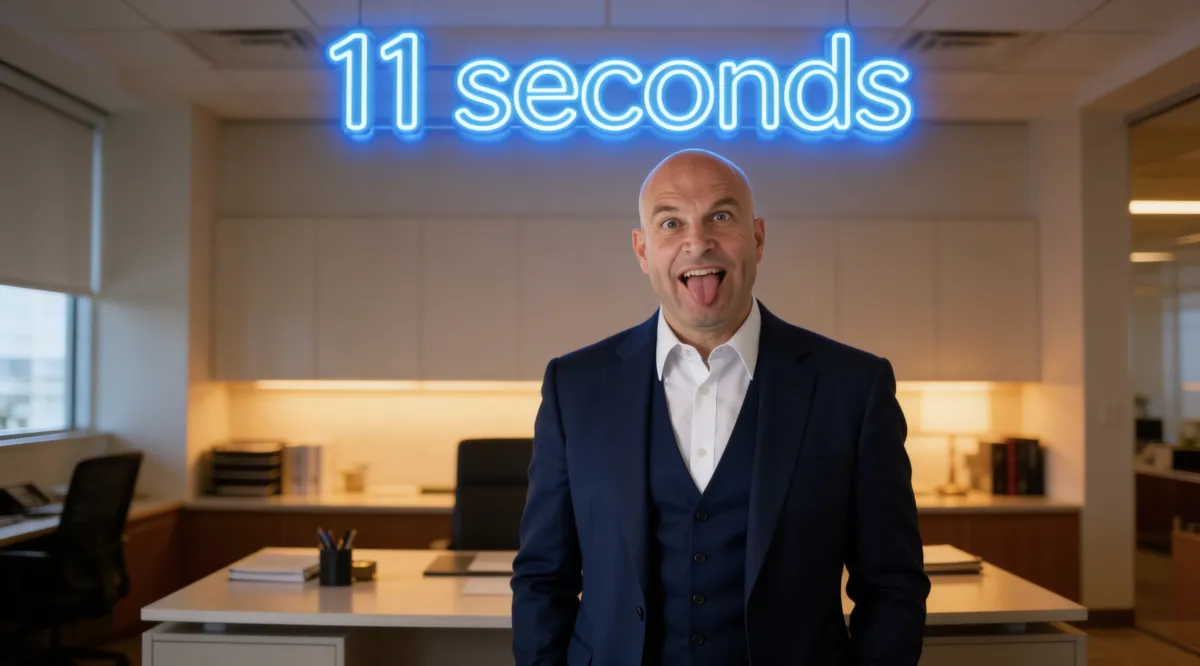
You Have 11 Seconds: The Neuroscience of First Impressions
Your brain has already made a decision about this person — before they've even finished saying hello.
That's not a metaphor. That's not motivational poster talk. That is your amygdala doing what it's been doing for 200,000 years — scanning, sorting, deciding. Safe or dangerous. Worth my time or not. Trust or don't.
And here's the thing nobody tells you: it doesn't matter how smart you are, how good your product is, or how many slides you prepared. If you lose those first 11 seconds? You're spending the rest of the conversation trying to climb out of a hole you didn't know you'd fallen into.
I know this because I fell into that hole. Professionally. In front of a room full of people.
I was at my last corporate job. Big meeting. Big room. I was — objectively — the most prepared person there. Best solution. Strongest data. I'd spent weeks on that pitch.
They picked someone else.
Not because of the product. Not because of the numbers. Because of the 11 seconds before the presentation even started.
The other guy walked in — and I watched it happen in real time. A specific eye contact sequence. The right handshake. He said four words before he even sat down — and the room was already his.
I didn't have the language for what I'd just witnessed. So I spent the next 10 years figuring it out.
Today — I'm giving you the whole system.
Let's talk about what's actually happening inside the brain of the person you're meeting.
In 400 milliseconds — that's less than half a second — the trust decision has already begun to form. Before your conscious brain has even processed what's happening. The brain cannot NOT judge. It's not rude. It's not shallow. It is a survival mechanism that kept your ancestors alive.
Every meeting. Every pitch. Every Zoom call where you turn your camera on. Every introduction at a networking event. The scan is running.
And the brain is not scanning for what you think it's scanning for.
It doesn't start with your resume. It's not reading your credentials. It is scanning for three things — in a very specific order.
Number one: Are you a threat, or are you safe? (seconds one through three) Number two: What is your status level? (seconds four through seven) Number three: Do I actually like you? (seconds eight through eleven)
Three phases. Eleven seconds. Let's break down each one.
Phase 1
The amygdala fires before the cortex even knows what's going on. It's reading your body, not your words.
Eye contact first. Too much eye contact reads as aggression. Too little reads as deception. There's a specific window — and most people are outside it without realizing.
The brain also reads micro-expressions — tiny flashes of emotion on your face that last 1/25th of a second. You can't fake your way past this. The brain detects inauthenticity at a neurological level. If you're nervous and pretending you're not, they know. They don't know that they know — but they feel it.
Your voice, too — before the words register, the brain is reading pitch, pace, and steadiness. A voice that's tight and rushed signals stress. A voice that's calm and measured signals safety.
And proximity. How you position your body when you enter a room. Whether you're angled toward someone or slightly away.
The tactical fix here is what I call the Anchored Entry.
Deliberately slow down your first three seconds. Not awkwardly. Intentionally. Walk in like you've been in this room a thousand times. Most people speed up when they're nervous — they rush the entrance, they rush the handshake, they rush to start talking to fill the silence. That rushing is the signal that triggers the threat response. Slow it down.
Phase 2
Hierarchy is primal. Humans have been sorting status signals for millennia. The brain does it automatically, and it does it fast.
It's reading: your posture. Your movement quality — do you move like someone who owns the room or someone who's trying to be invisible? Your clothing — not expensive necessarily, but congruent. Does what you're wearing match the story you're telling about who you are?
And your handshake. Still matters. Firmness, duration, eye contact during — all of it is data.
But here's the trap that smart people fall into constantly — I call it the "brilliant but invisible" trap.
Over-explaining. Justifying yourself before anyone asked you to. Filling every pause with more words. Apologizing for your opinions before you state them. "I might be wrong but—" "This is probably a stupid question—" "Sorry to take up your time—"
Every one of those phrases is a status signal. A low one.
The tactical fix: the Power Pause.
Before you speak — especially in a high-stakes moment — take two seconds of silence. Don't rush to fill the air. That pause, to the other person's brain, reads as authority. It reads as someone who is comfortable taking up space. That two seconds does more work than a perfect sentence.
Try it in your next three meetings. It feels uncomfortable at first. That discomfort is your old pattern dying. Good.
Phase 3
Seconds eight through eleven. You've passed the threat scan, you've signaled status — now the brain is asking: do I actually want to be around this person?
This is where most people think it's about being charming or funny or charismatic. It's not. It's neuroscience.
There are two types of smiles. A Duchenne smile uses the muscles around both the mouth and the eyes — it's involuntary, it's genuine, and the brain recognizes it immediately. A forced smile uses only the mouth. The brain clocks that in milliseconds and files it under "performing."
Then there's the mirror neuron effect. Your emotional state — whatever you're actually feeling — creates an emotional response in the other person. If you walk in anxious and performing confidence, they feel slightly off around you without being able to explain why. If you walk in genuinely calm and interested, they feel calm and interested. You are not presenting to people. You are infecting them.
The single most powerful likability signal? Genuine curiosity about them.
Not the professional small talk. Not "so what do you do?" on autopilot. Actually wanting to know. Looking at them like they're interesting. Most people spend the entire first meeting thinking about what they're going to say next. The people who are impossible to forget? They're actually listening.
Here's the rule I live by: 80% of a first impression is how you make them feel. 20% is what you say.
Read that again.
Okay. So how do you put all of this into a system you can actually use? Three words.
Signal. State. Story.
Signal — what your body is transmitting in the first three seconds. Posture, energy, eye contact. This is trainable.
State — your neurological state before you walk in the room. Calm authority, or anxious performing? The room reads whichever one is true. Preparation and breathing are your tools here.
Story — the one sentence that makes someone want to know more. Not your job title. Not a summary of your CV. One sentence that opens a door.
Here's mine: "I help business owners become Unforgettable in 11 seconds — using brain science."
That's it. That's eleven seconds of Signal, State, and Story working together.
And yes — I just did that on purpose.
3 THINGS YOU CAN DO TODAY
No fluff, just actions:
One — run the 11-second test on your LinkedIn profile photo. Show it to five people. Ask them: what do you feel in the first eleven seconds? You will learn something.
Two — practice the Power Pause in your next three meetings. Before you respond. Just two seconds. Watch what happens.
Three — rewrite your introduction using Signal-State-Story. One sentence. Write it in the comments below. I'll tell you if it works.
Over the next 30 days, I'm breaking down the complete system — free. Every piece of it. Subscribe so you don't miss it.
And one last question — drop it in the comments:
When was the last time someone forgot your name the second after you told them?
Because that's not bad luck. That's a solvable problem. And we're solving it.
Message me and let us start your 11 seconds!