YOUR BUSINESS IS BLEEDING — AND IT'S NOT WHAT YOU THINK
The real reason your clients ghost you, your kids don't look up to you, and your partner feels alone in the same bed.
Let me ask you something uncomfortable.
When was the last time — the actual last time — you were truly present with your partner? Not in the same room. Not physically there while your phone was lighting up on the table. I mean there. Eyes on them. Heart in it.
Can't remember? You're not alone. And I don't mean that in the gentle, reassuring way. I mean it in the "this is a real problem affecting 60% of business owners" way. Sixty percent. More than half. More than half of the people running companies, closing deals, building empires — can't remember the last time they had a genuinely intimate moment with the person they chose to share their life with.
And the kids? Those little humans you're working so hard to provide for? Research keeps telling us the same thing: they don't want the vacation. They don't want the school fees. They want you. At the dinner table. At the school play. On a Tuesday evening doing absolutely nothing important. And right now, most of them aren't getting it.
Here's what kills me. The business owners I work with — and I've worked with a lot — are not bad people. They're not selfish or cold or neglectful. They are driven. They are on a mission. They genuinely believe that if they just close this one deal, finish this one project, land this one client, everything will balance out.
It won't. And deep down? You already know that.
The Hamster Wheel Nobody Talks About
Here's the thing about running a business nobody puts in the glossy case studies. You don't just lose clients. You lose yourself. And then — slowly, quietly — you lose the people who matter most.
The pattern goes like this. You work more. You tell yourself it's temporary. Your partner stops waiting up. Your kids stop running to the door when you come home. Your clients — the ones you fought so hard to win — they try you once, get something fine, and never come back. Not because you did anything wrong. Because you were forgettable.
Forgettable. That's the word that should keep you up at night more than revenue targets.
I've been there. Standing at a desk at 40 years old, staring at a bank account that didn't match the energy I'd burned. My wife's words still ringing in my head: "Thomas, we can't keep living like this." I had degrees. Experience. The "right" business. All the rational pieces in place. But nothing was clicking — not professionally, not personally. Not in any of the rooms of my life.
So I walked to the beach. Stood at the end of a pier. Stared at the sea. And cried. Big guy, 40 years old, crying for hours because I couldn't figure out what I was doing wrong.
I was doing everything wrong. But not in the way you'd expect.
The Real Problem: You Made It About You
Most business owners — and I'm including you here, read this twice — have built everything around themselves. Their products. Their services. Their goals. Their bottom line.
And that's exactly why 60% of your clients don't come back.
Not because your offering is bad. Not because the market is tough. Because you never made them feel great. You made them feel like a transaction.
Here's what brain science actually shows us — and I spent years studying this — the decision-making brain, the primal brain, doesn't care about your features, your case studies, your credentials. It makes and rationalizes a decision in 11 seconds based on one thing: does this person understand my frustration, and can they make me feel better?
That's it. That's the whole game.
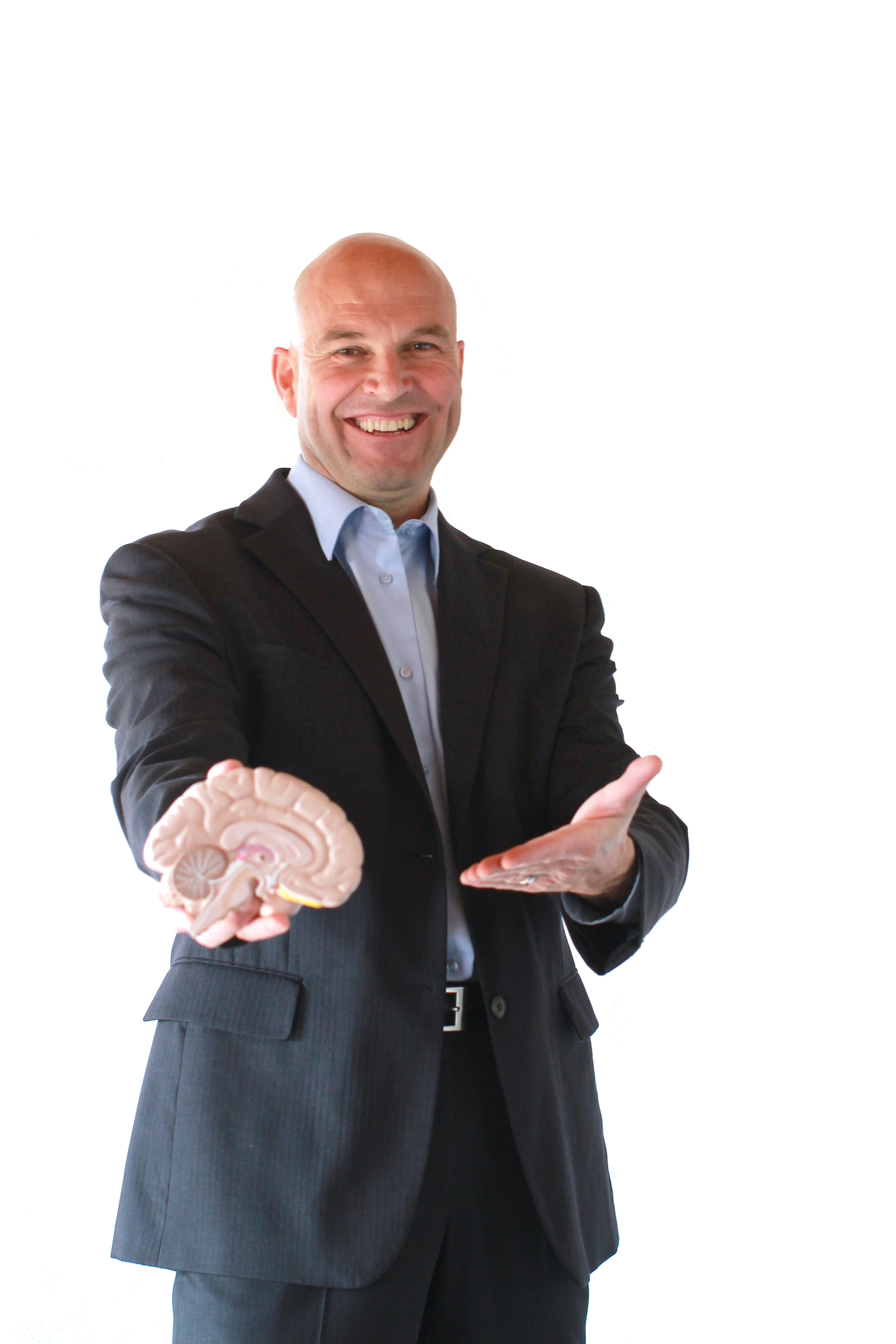
The rational brain — the neocortex, the wrinkled part you see when someone pulls a brain out of a bucket — that part doesn't make decisions. It shows up after the primal decision is already made, to rationalize it. So when you spend 45 minutes on a features deck or a polished pitch, you're talking to the wrong part of the room.
You're basically whispering to the assistant when the boss already walked out.
Your Clients Have Subconscious Frustrations. You're Ignoring All of Them.
Let me give you an example that breaks most people's brains when they first hear it.
You're selling website services to a restaurant owner. You're pitching SEO, social media reach, booking system integration. All rational stuff. All good stuff. But here's what's actually keeping that restaurant owner up at 3am: the fact that they never make it to their kid's football matches. That they said "next weekend" so many times their kid stopped asking.
That's the subconscious frustration. Not "I need more bookings." That's just the rational surface. Underneath it is: I want to spend more time with my family. And if you show them — in 7 seconds or less — that your service gives them back their Tuesday evenings? You've just sold to the decision maker in their brain. Everything else is paperwork.
The people who get this — really get it — stop chasing clients. Clients start chasing them.
There's a 2-38-60 split in every market. 60% of your market will never buy from you and never care about you. Forget them. They'll drain your time, your energy, and then ask for a discount on their way out. Another 38% will need you eventually — but not today. And 2%? That 2% needs you right now. Their frustration is so loud it keeps them up at night. Target those people. Serve them extraordinarily. And watch what happens: they tell the 38% about you. They become your white knights.
You stop running. You start attracting.
The Three Things You're Losing Right Now
I want to name the three losses happening in parallel in most business owners' lives — because they're connected in ways most people don't see.
Loss #1: Your clients don't come back. You're in permanent acquisition mode. Hunting. Pitching. Cold-calling. Starting from zero every single quarter. You have a 5% chance of closing someone new. A 70% chance of selling to someone who already trusts you. And yet you spend 90% of your energy on the 5%. That math is costing you a fortune.
Loss #2: Your reputation doesn't precede you. When clients talk about you, they should tell a story. A specific one. Something that made them feel understood, elevated, unforgettable themselves. Right now, most of them are saying something like "yeah, they were fine." Fine is forgettable. Fine dies.
Loss #3: Your family is grieving you while you're still alive. This is the one nobody says out loud. Your partner feels alone in a partnership. Your kids are growing up with an absent hero. You're chasing a success that, if it lands, you'll have no one to celebrate it with. Or worse — you'll celebrate with people who don't know the real you, because you stopped showing them years ago.
These three losses share one root cause: you built your business around yourself instead of around the people you serve. And "the people you serve" includes the ones at home.
The WHO: The Question That Changes Everything
So where do you start? Not with your product. Not with your pitch. Not with your marketing funnel.
You start with the most terrifying question any ambitious person can face: Who are you, really?
Not your LinkedIn title. Not your revenue. Not your degrees and your track record. Strip all of that away — the labels, the roles, the expectations your family put on you and the ones you put on yourself — and ask: if no one was watching, who would I be? What would I stand for?
Your brain responds to identity clarity in a measurable way. When you know who you are, cortisol drops. The amygdala quiets down. You stop second-guessing. You start deciding with conviction. You become magnetic — to clients, to partners, to your team. To your family.
For me, it took years to find it. I'm the Happy Tribes Builder. Everything I do — the workshops, the coaching, the books, this system — filters through that lens. Every client I choose, every project I launch, every story I tell. When you find your WHO, decisions get easy. Marketing gets easy. Relationships get easier. Not perfect. Easier.
Your WHO directly shapes your WHY. And your WHY is what makes people stay.
The WHY: Why Nobody Cares About Your Product
Simon Sinek said it. I'm saying it louder: nobody buys your product. They buy your reason for existing.
When Jobs built Apple, he wasn't selling computers. He was selling the belief that ordinary people could do extraordinary things. When Schultz built Starbucks, he wasn't selling coffee. He was selling a place to belong. When Branson built Virgin, he was selling the permission to live boldly.
These leaders became unforgettable because they led with WHY — and that WHY was deeply, stubbornly human.
Your WHY isn't your mission statement. It's not your USP. It's the story — raw, personal, possibly embarrassing — of why you do what you do. The Call that started everything. The Pit where you hit your lowest. The Search where you stumbled and failed and kept going. The Breakthrough where you finally understood.
Tell that story. In every pitch. On every website. On every phone call. Because when your primal brain tells your story, it activates physiological signals — micro-expressions, voice frequencies, body language — that the primal brain of the person across from you reads as: this is real. I can trust this.
A utility company agent once kept me on the phone for 30 minutes — not because of the problem I called about, but because he told me why he loves what he does. I'm going to ask for him by name every time I call back. He IS that brand to me now.
One human being. Thirty minutes. Changed my entire perception of a billion-dollar company. That's the power of WHY.
The TRIBE: Stop Selling, Start Leading
Here's a number that should permanently change how you run your business: you have a 70% chance of selling to someone who already trusts you. Seventy percent. Compared to 5% for someone who doesn't know you.
And yet most businesses spend most of their budget chasing strangers.
Humans are tribal. We have been for 100,000 years. We need to belong to something. We follow leaders who nourish us, who speak to our frustrations, who make us feel less alone. And here's the thing about belonging — when people feel like they belong to something you've built, they don't just buy. They recruit. They defend. They tattoo your logo on their arm.
Harley-Davidson figured this out. The average additional spend after a motorcycle purchase — on gear, accessories, tribe membership — is €9,000 in Europe. Because they weren't selling motorcycles. They were selling identity. Belonging. Tribe. And they nearly killed it in 2025 when forgetting their tribe!
Apple sold white earbuds when everyone else sold black ones. Not for audio quality reasons. For tribe signaling. "I'm one of us." And then the tribe bought more music, more devices, more storage, more everything.
You don't need a multinational budget to do this. You need clarity on who you're for, a story that resonates, and the discipline to nourish your people consistently — without always trying to sell them something. Give first. The reciprocity instinct built into the primal brain does the rest.
Ethical Persuasion: Talk to the Brain That Actually Decides
Here's where it gets science-y, but stay with me — because this is the part that explains why your best pitch isn't working.
The brain processes 10 million bits of information per second. The part that makes decisions processes 60. Sixty bits. Your microwave handles more. And this tiny, ancient, deeply irrational decision-maker — called the primal brain — has been running the same software for 50,000 to 100,000 years. It doesn't know about quarterly targets. It doesn't speak business. It speaks survival, belonging, status, and fear.
Every decision your clients make — every one — starts here. The rational brain shows up after, to write the justification story. But the decision? Already made. In 11 seconds.
So when you speak, you have two options. You can speak to the rational brain — which has no decision-making power but loves feeling smart — with your features and your data and your credentials. Or you can speak to the primal brain — the actual decision-maker — with contrast, emotion, story, and a picture of a better life.
The "What if" question is one of the most powerful primal tools you have. "What if you could have dinner with your family every night this week?" "What if your clients called you back instead of the other way around?" Two seconds. Hits the frustration. Shows the solution. Doesn't mention your product once. The primal brain starts solving the problem before you even open your mouth.
Then — and this is critical — you shut up for 4 seconds. Real seconds. Count them. The silence is where the decision happens.
Communication: 93% of Your Message Has Nothing to Do With Words
This is the part most business owners never work on. Because they think communication is about what you say.
It's not.
Albert Mehrabian's research showed it clearly: words are 7% of your message's impact. Your voice — pitch, pace, pause — is 38%. Your body is 55%. You can be technically right about everything and lose the room because your voice is flat and your hands are in your pockets.
The most unforgettable communicators in history — Jobs, Robbins, Branson — they mastered their bodies first. They practiced. Not once. Not twice. Obsessively. Until the rational brain could manage the room while the primal brain ran the content automatically.
You don't need to be a rockstar speaker. You need to practice enough that your primal brain is on autopilot — freeing your rational brain to actually listen to the room. To notice when someone's energy shifts. To feel when to pause and when to lean in.
And speaking of leaning in — when someone gives you an objection? Don't step back. Step forward. Physically. Subtly. That's the tribe leader move. It says, at the subconscious level: I'm not scared of your challenge. I'm still here.
The Unforgettable Leader's Equation
So here's where it all lands.
Your business isn't growing the way it should because you're focusing on the wrong people (the 60%), speaking to the wrong brain (rational), selling instead of leading, and running so hard professionally that you've gone quiet at home.
The formula is simple. Not easy — simple.
Know who you are (WHO). Know why you do it (WHY). Build a community around that truth (TRIBE). Speak to the decision-making brain with emotion, story, and subconscious frustration (ETHICAL PERSUASION). And deliver it all with your body, your voice, and your presence (COMMUNICATION).
Do those five things consistently, and something shifts. Clients stop leaving. Referrals start arriving. And at home — because the same brain science that governs your clients governs your partner and your kids — the conversations get easier. The presence gets real. The intimacy comes back.
Here's the paradox at the heart of everything: the more you focus on making other people great, the greater you become. Not as a business strategy. As a law of human nature.
Your greatness is measured by the greatness you create in others.
Stop playing it safe. Stop hiding behind the rational pitch and the polished deck and the twelve-hour days. Get wet. Get real. Make your clients feel seen and your family feel chosen.
And you — you will become the one nobody forgets.
Ready to build the business and the life you actually want?
Get the Make Me Great! book — the complete system for becoming unforgettable to your clients, your team, and the people you love.